
Laser Etching vs Laser Engraving: What’s the Difference?
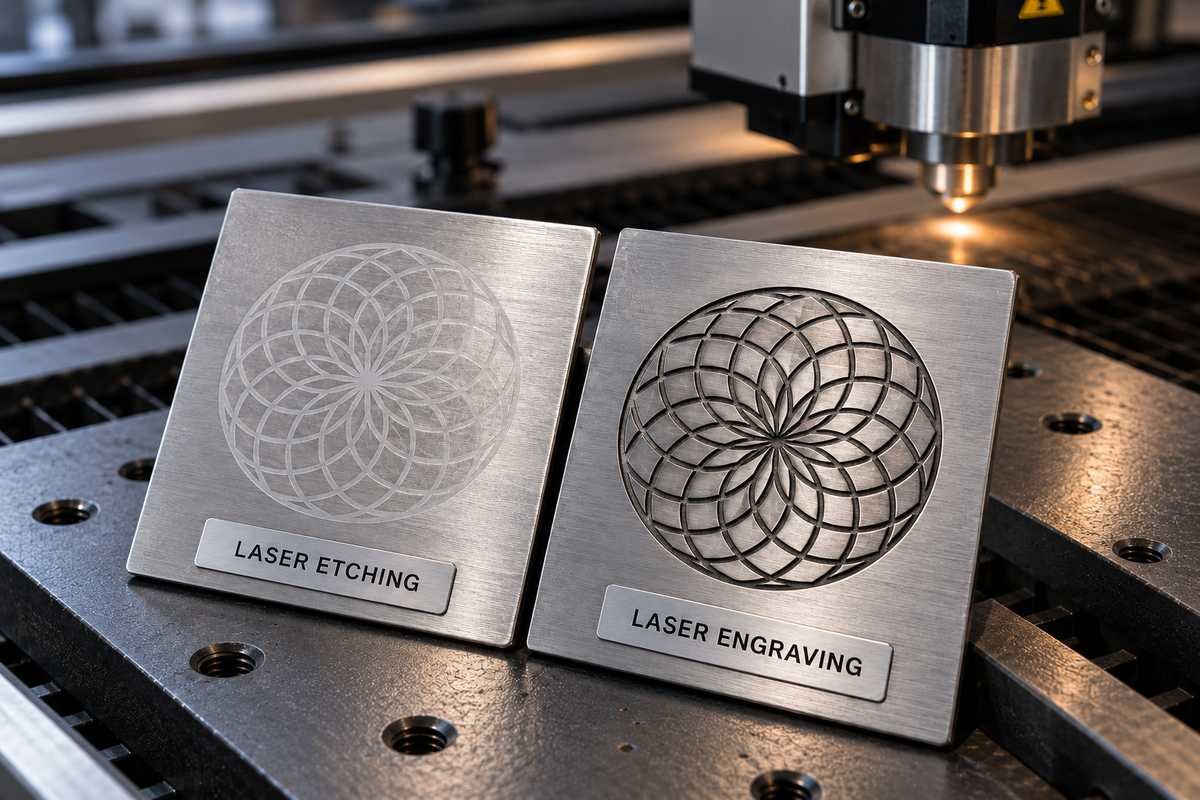
Table of Contents
Quick Answer
Laser etching and laser engraving both create permanent laser-made designs, but they affect the surface differently. Engraving removes material to create a recessed, usually tactile mark. Etching changes only a very shallow surface layer, often with limited material removal. Etching is generally faster; engraving usually offers greater resistance to heavy abrasion. The right choice depends on material, depth, finish, durability, and production speed.
The terms laser etching and laser engraving are often used interchangeably, even by machine suppliers. That can make equipment selection harder than it needs to be. In this article, “laser etching” refers to a shallow surface-alteration process that may melt, modify, or remove a very thin layer, while “laser engraving” refers to intentional material removal that creates a recessed cavity. The exact physical result still depends on the material, coating, laser source, pulse behavior, focus, and settings.
For manufacturers, sign shops, fabricators, product-marking teams, and machine buyers, the practical question is not which term sounds more precise. It is which process produces the required depth, contrast, wear resistance, cycle time, and surface condition on the actual part. The sections below compare those outcomes and then connect them to Hightech fiber, MOPA, UV, and CO₂ marking options.
Contents
- Laser Etching vs Laser Engraving at a Glance
- Key Differences Between Laser Etching and Engraving
- Laser Etching vs Engraving on Metal
- Laser Marking vs Etching vs Engraving
- Which Is Better: Laser Etching or Laser Engraving?
- Which Laser Machine Should You Use?
- Frequently Asked Questions
Laser Etching vs Laser Engraving at a Glance
Both processes can produce permanent marks, but they prioritize different outcomes. Etching favors fast, shallow surface effects and limited material removal. Engraving favors depth, tactile definition, and resistance to heavy wear. The table below is a practical comparison rather than a universal process standard, because the word “etching” is used differently across materials and suppliers.
| Factor | Laser Etching | Laser Engraving |
|---|---|---|
| Surface interaction | Very shallow surface modification; may melt, alter, or remove a thin layer depending on material and process. | Removes material to create a recessed cavity. |
| Typical feel | Smooth to slightly raised or textured. | Recessed and usually tactile. |
| Depth | Shallow. | Shallow to deep, depending on material, power, passes, and target result. |
| Speed | Generally faster because less material is changed or removed. | Generally slower as the required depth and number of passes increase. |
| Durability | Permanent for many normal-service applications, but usually less resistant to heavy abrasion than deep engraving. | High abrasion resistance when sufficient depth is created. |
| Heat / material impact | Lower material removal; useful where surface disruption should be limited. | More material removal and potentially more process time and heat input. |
| Best use cases | Fast identification, contrast, shallow logos, thin or sensitive parts, repeated production marks. | Deep IDs, tactile designs, wear-prone parts, recessed decorative work. |
| Main cost drivers | Cycle time, machine type, setup, handling, volume, extraction and rework. | Pass count, target depth, laser power, cycle time, extraction and any finishing. |
Key Differences Between Laser Etching and Engraving
The difference between laser etching and engraving is clearest when you compare the required depth, wear resistance, throughput, cost, and surface appearance rather than relying on process labels.
Depth and Surface Finish
Laser engraving intentionally removes material. The focused beam heats the workpiece until material is displaced or vaporized, and repeated passes can create a measurable recess. The finished mark can be felt with a fingertip and can remain visible even when the surrounding surface is worn or refinished.
Laser etching stays much closer to the surface. Depending on the substrate and parameters, it may create local melting, micro-texture, a slight raised effect, contrast, or limited removal of a thin layer. This suits identification that does not need a pronounced cavity. Avoid using one depth number as a universal boundary; actual depth depends on the machine, material, and settings.
Durability and Wear Resistance
Both etching and engraving can be permanent, but permanence is not the same as resistance to severe wear. A deep engraved mark is physically recessed into the part, so it generally survives abrasion, polishing, blasting, repeated handling, or other surface loss better than a shallow mark. For serial numbers or identification that must remain readable through harsh downstream processing, engraving is often the safer choice.
Etched marks can still be durable in normal service, but shallow surface effects are more exposed to heavy abrasion. Base the choice on the part’s lifecycle, including handling, cleaning, weathering, coatings, and any later finishing steps.
Speed and Throughput
Laser etching is generally faster because it changes less material. A shallow mark may need fewer passes and less dwell time than a deep engraving, which can improve throughput in high-volume identification work. That is one reason etching is common for repeated logos, codes, and production information where measurable depth is unnecessary.
Real cycle time also depends on artwork size, hatch spacing, fill density, laser power, pulse settings, focus, loading, and pass count. A small engraved code can be quicker than a large etched graphic, so time the complete load-mark-unload cycle on a real sample.
Cost and Energy Use
There is no universal dollar difference between etching and engraving. Cost depends on machine type, power, pass count, cycle time, fixtures, extraction, handling, and rework. A faster shallow etch can reduce machine time per part in volume production.
Deeper engraving can take more time and energy, but that cost is justified when depth prevents identification loss or repeat marking. Compare cost per acceptable finished part, not just laser power or machine price.
Appearance, Texture and Part Integrity
Engraving produces a recessed, tactile result that works well for deep logos, durable identifiers, tools, nameplates, molds, and decorative work where visible depth is part of the design. Etching is typically flatter and can emphasize contrast, reflectivity, color response, or fine detail with less physical disruption to the surface.
On thin, finished, coated, or heat-sensitive parts, limiting material removal can be important. If the surface must stay flat or intact, a shallow process is easier to control. Very sensitive substrates may require a lower-heat marking technology instead of deeper processing.
Laser Etching vs Engraving on Metal
For direct metal work, fiber laser marking and MOPA fiber systems are the most relevant Hightech technologies. Fiber lasers are used for permanent identification and engraving on compatible metals, while MOPA systems add wider pulse-duration and frequency control for specialized surface effects. The best process still depends on the alloy, coating, surface finish, required depth, and durability target.
Test representative parts before production. The same nominal metal can respond differently because of alloy chemistry, anodizing, coatings, polish, oxide condition, or prior surface treatment.
Stainless Steel
For stainless steel, start with the required end condition. If the mark must remain readable after aggressive abrasion or surface removal, engraving can provide the physical depth needed. If the part needs a smooth surface and preservation of the surface condition is important, a non-removal marking method such as annealing may be preferable to deeper engraving or aggressive surface removal.
Hightech’s MOPA laser marking machine is a 1064 nm MOPA fiber system with adjustable pulse duration and repeat frequency. Hightech positions it for stainless-steel color marking, precision surface processing, and fine line work. That pulse flexibility is useful when the visual finish and heat input need more control than a conventional fixed-pulse setup can provide.
“Etching is better for stainless steel” is too broad. Choose according to color or contrast, smoothness, corrosion-sensitive surface behavior, tactile depth, and wear resistance, then confirm the result on the specific grade and finish.
Aluminum and Anodized Aluminum
Bare aluminum and anodized aluminum should not be treated as the same marking problem. On bare aluminum, fiber laser parameters can be adjusted for surface marking or deeper material removal. If the specification calls for a recessed identifier, engraving removes the base metal. If the goal is a shallow contrast effect, the process can stay closer to the surface.
Anodized aluminum adds a functional and decorative oxide layer, so the decision may be about changing, blackening, or selectively removing that layer rather than engraving deeply into the base metal. Hightech specifically positions its MOPA laser marking machine for anodized-aluminum blackening and precision layer stripping. Those are different outcomes from deep engraving, and each needs its own parameter window.
Verify contrast, edge quality, coating preservation, and abrasion resistance on the real anodized finish. Dye, oxide thickness, alloy, color, and the anodizing process can change the result.
Laser Marking vs Etching vs Engraving
Laser marking is the broadest term. It describes using a laser to create identification, graphics, codes, or other permanent or durable information on a part. Etching and engraving are two ways that laser-material interaction can create that result, while other marking approaches can change color or chemistry with little or no material removal. If you need a broader comparison of marking and engraving terminology, see Hightech’s laser engraving vs laser marking guide.
For this article, the practical distinction is surface outcome. Etching stays very shallow and is usually selected for speed, contrast, and limited disruption. Engraving removes material to create a recessed feature and is selected when depth, tactile feel, or heavy-wear resistance matters. “Marking” describes the job; “etching” and “engraving” describe different ways the surface can be changed. Terminology still varies by supplier, so specify the required outcome in a drawing or process requirement instead of relying only on the word used for the process.
| Term | Practical meaning | Typical reason to use it |
|---|---|---|
| Laser marking | Broad identification or graphics process; may include several surface-interaction methods. | Codes, text, logos, traceability and product information. |
| Laser etching | Very shallow surface alteration or limited removal. | Fast contrast, shallow identification and reduced surface disruption. |
| Laser engraving | Material removal that creates a recessed cavity. | Depth, tactile finish and greater resistance to heavy abrasion. |
Which Is Better: Laser Etching or Laser Engraving?
Neither process is universally better. The better process is the one that meets the part requirement with the least unnecessary material removal, cycle time, and rework. Use the matrix below as a first screening step, then confirm the result with sample testing.
| Requirement | Choose Laser Etching When… | Choose Laser Engraving When… |
|---|---|---|
| Production speed | Throughput is a priority and a shallow mark meets the specification. | Depth is required even if cycle time is longer. |
| Depth / feel | You want a surface-level or minimally tactile effect. | You need a visible recess or tactile result. |
| Wear environment | Normal handling and service wear are expected. | The mark must survive heavy abrasion, polishing, blasting, or refinishing. |
| Part surface | You want to limit material removal on a finished, thin, or sensitive part. | The part can tolerate deliberate material removal. |
| Visual goal | Contrast or a shallow surface effect is more important than depth. | Recessed graphics, IDs, or decorative depth are part of the design. |
If the part is stainless steel and surface integrity is the priority, also consider whether annealing or another non-removal marking method better fits the specification. If the part is a heat-sensitive polymer or coated component, a UV marking process may be a better technical choice than forcing a deeper engraving process.
Which Laser Machine Should You Use?
Hightech’s laser marking machines category includes fiber, MOPA fiber, UV, and CO₂ technologies. Select first by material and required surface result, then by field size, detail, speed, fixtures, and workflow. For a broader buyer framework, see how to choose a marking machine.
Fiber Laser Marking Machine: General Metal Marking and Engraving
Hightech’s Fiber Laser Marking Machine is available in 30 W and 50 W configurations and has a published marking speed up to 7,000 mm/s. Hightech positions it for permanent text, graphics, industrial identification, and engraving on compatible metals including steel, aluminum, copper, and brass, with additional supported materials depending on testing.
Choose standard fiber for general metal identification or engraving when wider MOPA pulse control is unnecessary. Do not treat a published marking-depth value as a universal engraving limit; depth varies with metal, focus, power, fill strategy, and pass count.
MOPA Fiber Laser: Stainless Color, Anodized Aluminum and Pulse Control
Hightech’s MOPA Laser Marking Machine uses a 1064 nm MOPA fiber source with published pulse duration from 2 to 500 ns and repeat frequency from 1 to 4,000 kHz. Hightech highlights stainless-steel color marking, anodized-aluminum blackening, precision stripping, deep engraving, and detailed surface processing as application areas.
MOPA is a fiber-laser architecture with more flexible pulse control, not a separate material category. It is useful when appearance depends on tuning heat input and pulse behavior rather than simply increasing depth.
UV Laser: Fine, Low-Heat Marking
The Hightech UV Laser Marking Machine uses a 355 nm source with published power from 3 to 10 W. It is positioned for fine marking where limited heat input and small details matter, including coated surfaces, electronics, and other sensitive parts.
UV is not the first choice for deep engraving. Consider it when a part could deform, discolor, char, or lose surface quality under higher thermal load, especially when fine detail and part integrity matter more than depth.
CO₂ Laser: Organic and Compatible Non-Metal Materials
Hightech’s CO₂ Laser Marking Machine is designed for compatible non-metallic materials such as leather, wood, plastic, and two-color board. It is suited to high-speed text, logos, batch information, and decorative surface marking on materials that absorb CO₂ wavelengths effectively.
CO₂ is not the default choice for direct bare-metal work; compare fiber and MOPA first. For non-metals, especially plastics, test the actual material for mark quality and safe processing before production.
Frequently Asked Questions
Is laser etching the same as laser engraving?
No. In this article, laser etching means a very shallow surface alteration with limited material removal, while laser engraving intentionally removes material to create a recessed cavity. The terms are sometimes used loosely by suppliers, so the safest approach is to specify the required surface result, depth, contrast, and durability instead of relying on the process name alone.
How deep is laser etching compared with laser engraving?
Laser etching is generally much shallower than laser engraving, but there is no single universal depth boundary that applies to every machine and material. Etching stays close to the surface, while engraving can be built deeper through power, focus, hatch strategy, and repeated passes. Any numeric depth requirement should be validated on the actual substrate and laser configuration.
Which is more durable: laser etching or laser engraving?
Deep laser engraving is usually more resistant to heavy abrasion because the mark is recessed into the part. Laser etching can still be permanent and durable for normal handling, product identification, and many indoor or controlled applications. The correct choice depends on whether the mark must survive polishing, blasting, refinishing, weathering, cleaning, or other processes that can remove the outer surface.
Which is faster: laser etching or laser engraving?
Laser etching is generally faster because it changes less material and often needs fewer passes. However, actual cycle time depends on the artwork size, fill density, hatch spacing, laser power, scan speed, field size, focus, and loading method. A large filled etch may take longer than a small engraved code, so time the complete production cycle on a real sample.
Is laser etching or engraving better for stainless steel?
It depends on the required finish. Choose engraving when measurable depth and heavy-wear resistance are priorities. For smooth, corrosion-sensitive stainless surfaces, a non-removal method such as annealing may be preferable. MOPA fiber can also provide specialized pulse control for color and surface effects. Always test the actual stainless grade and finish before approving production settings.
Is laser etching or engraving better for aluminum?
First separate bare aluminum from anodized aluminum. Bare aluminum can be surface-marked or engraved with a suitable fiber laser depending on the required depth. Anodized aluminum often calls for controlled interaction with the oxide layer, such as blackening or selective layer processing, rather than deep base-metal removal. MOPA fiber is particularly useful when pulse control and anodized-surface appearance matter.
Can the same fiber laser both etch and engrave metal?
Often, yes. A fiber laser can create different metal-marking outcomes by changing power, pulse behavior, scan speed, frequency, hatch, focus, and the number of passes. The available process window depends on the specific laser source and material. Standard fiber is strong for general metal marking and engraving; MOPA fiber provides more pulse-control flexibility for specialized surface effects.
Which is cheaper: laser etching or laser engraving?
Etching is often less expensive per part when it achieves the required result faster and with fewer passes, but there is no universal price difference. Unit cost depends on machine time, power, handling, fixtures, extraction, production volume, and rework. Engraving can be the more economical choice when extra depth prevents the mark from being lost during downstream wear or finishing.
Final Decision: Match the Process to the Required Surface Result
Choose laser etching for a fast, shallow surface effect with limited material removal. Choose laser engraving for a recessed, tactile mark or greater resistance to heavy abrasion. On stainless steel, anodized aluminum, sensitive plastics, or coated parts, pulse control, annealing, or a lower-heat source may be more important than the etching-versus-engraving label.
The most reliable machine-selection process is to define the material, surface finish, required depth, contrast, wear environment, artwork, and target cycle time, then test the actual part. Hightech offers fiber, MOPA, UV, and CO₂ marking machines for different material and process requirements. For a deeper technology overview, see types of laser marking machines and the guide to fiber laser marking applications.
Latest contents


Prefer a callback? Share your details and requirements below.
Your details will only be used to respond to this request.