


Best Fiber Laser Cutting Machine Buyer’s Guide
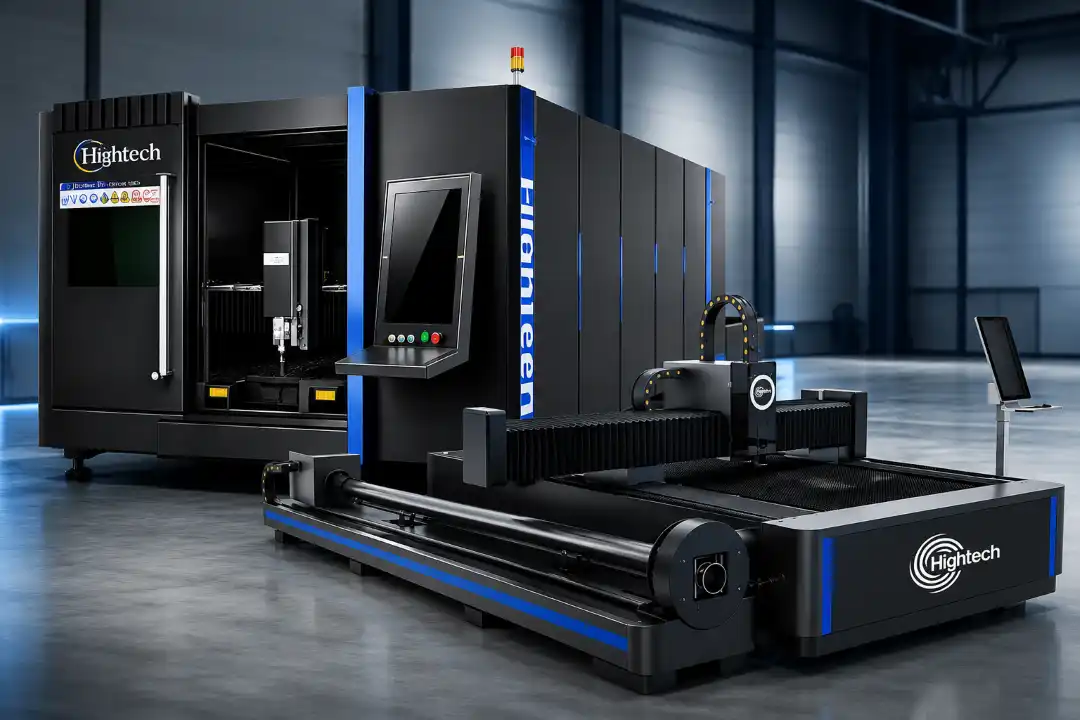
Table of Contents
Choosing the best fiber laser cutting machine requires more than comparing laser power or maximum cutting speed. The right system must match your material types, sheet dimensions, thickness range, production volume, available floor space, automation requirements, and long-term operating budget.
This guide compares four options in the Hightech range and explains how to evaluate them against your production requirements. Use the same criteria when comparing quotations from other suppliers: suitable work format, tested part quality, complete job time, operating cost, and support arrangements.
Quick Answer: What Is the Best Fiber Laser Cutting Machine?
For combined sheet-and-tube work, start with the HT 3015 ST. For 4,000 × 1,500 mm sheet production with an exchangeable table and a 6,000W source, shortlist the HT 4015H. Consider the FC-1325 when a 1,300 × 2,500 mm bed fits your normal stock, or the FC-2040 when you need a wider 2,000 × 4,000 mm sheet format.
These are starting points for selection. The final choice should pass a cutting test on your materials and drawings, meet your required output, and fit the complete installation budget.
| Production need | Starting model | Main distinction | Check before choosing |
|---|---|---|---|
| Regular sheet-and-tube orders | HT 3015 ST | Sheet-and-tube processing; 1,500W, 3,000W, 6,000W, and 12,000W options | Sheet dimensions, tube limits, chosen power, and changeover time |
| Long sheets with table exchange | HT 4015H | 4,000 × 1,500 mm; 6,000W Raycus source; exchangeable work table | Full installation space, loading method, and electrical supply |
| Wider sheet layouts | HT FC-2040 Exchange Table | 2,000 × 4,000 mm work format | Required table arrangement, rated load, and full handling cycle |
| Compact sheet formats | HT FC-1325 | 1,300 × 2,500 mm work format | Whether your purchased sheets fit without preprocessing |
Best Fiber Laser Cutting Machines from HT Industry
HT Industry offers fiber laser systems with different work areas, power configurations, motion systems, and loading arrangements. Buyers should compare each model against their actual production mix instead of selecting a machine based only on its maximum wattage.
HT 3015 ST – For Businesses Cutting Both Sheets and Tubes
Businesses that process both flat metal sheets and tubes can consider the HT 3015 ST Fiber Laser Cutting Machine. It supports sheet-and-tube processing, making it relevant when both processes are part of regular production.
Available laser power options are 1,500W, 3,000W, 6,000W, and 12,000W. This range allows buyers to configure the machine according to their most common materials and thicknesses rather than paying for unnecessary power.
The machine includes an autofocus cutting head with capacitive height control. Its positioning accuracy is ±0.03 mm, repeat positioning accuracy is ±0.02 mm, and maximum acceleration is 1.5G. Supported metals include carbon steel, stainless steel, aluminum, copper, brass, and galvanized sheet.
Selection check: Establish your sheet-to-tube workload before choosing a combined machine. Ask for the sheet-bed dimensions, supported tube shapes and sizes, loading limits, and changeover procedure. The 1–35 mm thickness range covers different configurations; it does not mean every listed power can cut every supported metal to 35 mm.
HT 4015H – For Long Sheets and an Exchange-Table Workflow
The HT 4015H Fiber Laser Cutting Machine combines a 4,000 × 1,500 mm cutting area with an exchangeable work table. Its additional working length makes it suitable for longer components, while the exchange-table design allows operators to prepare one table while cutting continues on the other.
The configuration includes a 6,000W Raycus source, BLT 421H cutting head, CypCut 4000E control, automatic lubrication, and an aviation-aluminum gantry beam. Motion specifications include 120 m/min maximum idle speed, 1.5G maximum acceleration, ±0.03 mm positioning accuracy, and ±0.02 mm repeat positioning accuracy.
Selection check: The machine dimensions are 11,755 × 2,970 × 2,400 mm, and the power supply is three-phase, five-wire 380V/50Hz. Allow additional room for utilities, loading, maintenance, and material storage. The 120 m/min figure is travel without cutting; assess production speed with your actual parts.
HT FC-2040 Exchange Table Fiber Laser Cutting Machine – Reduced Loading Downtime
The HT FC-2040 Exchange Table Fiber Laser Cutting Machine is an option for a 2,000 × 4,000 mm sheet format. That width matters when purchased sheets or part layouts exceed a 1,500 mm working width.
The HT-FC configuration uses a Raycus source, BLT 421H cutting head, CypCut control, Delta servo motors, and automatic lubrication. Its motion specification includes 120 m/min maximum idle speed, 1.5G maximum acceleration, ±0.03 mm positioning accuracy, ±0.02 mm repeat positioning accuracy, and a 300 mm Z-axis stroke.
Selection check: Specify the table arrangement, exchange sequence, rated load, and required operating clearances in the quotation. Demonstrate the complete loading-to-unloading cycle before using an expected reduction in handling time to justify the purchase.
HT FC-1325 Fiber Laser Cutting Machine – Compact Industrial Sheet Processing
The HT FC-1325 Fiber Laser Cutting Machine provides a 1,300 × 2,500 mm working format for workshops that do not regularly process full 1,500 × 3,000 mm sheets.
Its HT-FC configuration uses the source, cutting head, control, lubrication, and motion specifications described above. The smaller bed is relevant when your parts and normal stock fit within it; it does not automatically establish the lowest production cost.
Selection check: Compare the purchase saving with any extra stock preparation. If your normal sheet is 1,500 × 3,000 mm, include the time and cost of sizing it down, moving it twice, and managing the remaining material. Request a written component list, laser-power configuration, table-load rating, and material-specific cutting chart.
How to Choose the Best Fiber Laser Cutting Machine for Your Business
Businesses looking for a reliable fiber laser cutting machine should compare the complete production system—not just the laser source.
Laser Power Requirements
Higher laser power can increase cutting speed and expand practical thickness capacity, but power should be selected according to the materials processed every day.
A machine capable of occasionally separating a thick plate may not cut that thickness economically at production speed.
Use this selection process:
- Define the regular workload. List the grades and thicknesses that account for most machine hours, together with the edge finish and part quantities required.
- Request comparable cutting data. Compare candidate powers using the same material, thickness, gas, geometry, and acceptance criteria. Include piercing and finishing time.
- Test the limiting jobs. Include your thickest routine material, smallest important features, and any reflective metal you regularly process.
- Price the complete installation. Compare the additional machine and utility cost with the extra acceptable parts the higher-power configuration can produce.
Cutting Area and Machine Size for Different Production Needs
The work area should match the sheets your business purchases most frequently. A smaller table may reduce the initial investment and workshop footprint, but it can require sheets to be cut manually before laser processing.
A larger table can improve nesting and reduce preprocessing, although it also requires more installation space, material-handling capacity, extraction volume, and operator access.
Measure the complete machine footprint rather than only the cutting area. Include room for:
- Loading equipment
- Sheet storage
- Scrap removal
- Chiller and extraction systems
- Electrical cabinets
- Maintenance access
- Forklift or crane movement
Cutting Speed, Accuracy, and Production Efficiency
Maximum cutting speed does not represent the complete production cycle. Actual output is affected by piercing, acceleration, cornering, head movement, material loading, part unloading, nozzle changes, gas switching, and operator delays.
Positioning and repeat-positioning accuracy are also different. Positioning accuracy indicates how closely the machine reaches the programmed location, while repeatability shows how consistently it returns to the same position.
For most buyers, repeatable production quality is more valuable than an impressive top-speed figure that applies only under ideal conditions.
A high precision fiber laser cutter should be assessed on finished parts as well as axis specifications. Focus, nozzle selection, gas pressure, material thickness, and cutting speed affect the result. Do not treat a positioning figure as a guaranteed tolerance on every cut component.
To evaluate an accurate fibre laser cutting machine, agree an inspection plan before the demonstration. Test repeated parts across the bed, measure critical features, inspect holes and corners, and record any deburring or rework required.
For a high efficiency fiber laser cutter, compare accepted parts per shift. Include time spent preparing files, changing sheets, sorting parts, and maintaining the machine.
For example, consider an illustrative job producing 100 acceptable parts. Reducing cutting time from 40 to 30 minutes while handling remains 20 minutes changes total job time from 60 to 50 minutes. Output rises from 100 to 120 parts per hour. This calculation shows why a reduction in cutting time does not translate directly into the same percentage increase in complete-job output.
Automation Features: Exchange Tables, Auto Focus, and Smart Controls
Automation should remove a measurable production bottleneck. An exchange table is useful when loading and unloading consume a significant part of each cycle. Autofocus reduces manual lens-position adjustments when changing materials or thicknesses. Automatic height control helps maintain the correct distance between the nozzle and uneven sheet surfaces.
Nesting software can reduce material waste by arranging parts efficiently, but buyers should also evaluate file preparation, remnant management, common-line cutting, lead-ins, collision avoidance, and integration with existing CAD/CAM workflows.
Material Compatibility
Industrial fiber lasers are commonly selected for carbon steel, stainless steel, galvanized sheet, aluminum, brass, and copper. The appropriate assist gas and cutting parameters vary by material.
Oxygen may provide faster cutting on some carbon-steel applications, while nitrogen is often selected when oxidation-free edges are required. Compressed air can reduce gas costs for suitable materials and quality requirements.
Reflective metals such as copper and brass require a properly configured source, cutting head, and process setup. Always verify material compatibility for the exact machine configuration.
Compare fiber laser vs plasma cutting before committing to a metal-cutting system, using the thickness mix, edge-quality target, and total cost of ownership.
What Does a Fiber Laser Cutting Machine Really Cost?
The machine price is only the starting point. Compare what each quotation includes and what your facility must provide before production can begin.
| Cost area | What to confirm |
|---|---|
| Machine configuration | Work area, laser source and power, cutting head, controller, table arrangement, and safety equipment |
| Supporting equipment | Chiller, extraction, compressor or gas supply equipment, and electrical installation |
| Software and commissioning | Licenses, installation, operator training, acceptance tests, and update terms |
| Delivery | Freight, insurance, import charges, unloading, and rigging responsibilities |
| Continuing operation | Electricity, gas, consumables, filters, maintenance, labor, and secondary finishing |
| Service | Warranty scope, spare-part supply, remote support, and on-site service charges |
Common Mistakes When Choosing a Fiber Laser Cutting Machine
One of the most common mistakes is buying the highest available wattage without calculating whether the additional power will improve actual production. Other buyers select a work area that cannot accommodate their standard sheets or underestimate the space required for loading and maintenance.
Ignoring assist-gas costs, extraction requirements, electrical capacity, operator training, and local technical support can also increase long-term expenses. Another mistake is comparing machines using maximum speed or thickness alone. These figures do not reveal piercing performance, edge quality, repeatability, loading time, or output per shift.
A lower quotation can also cover a different machine package. Compare the source, head, controls, handling equipment, software, utilities, and service scope before deciding which offer represents better value.
Why Choose HT Industry Fiber Laser Cutting Machines?
HT Industry supplies machinery for fiber laser cutting, CO₂ processing, laser welding, CNC routing, bending, and related manufacturing applications. Its published product range includes different table dimensions, power configurations, control systems, autofocus heads, and material-handling options.
Available support may include setup guidance, operation training, remote troubleshooting, software assistance, spare-parts supply, and long-term technical consultation. Local or in-person support depends on the destination country, agent availability, scheduling, and purchase agreement.
Conclusion: Selecting the Right Fiber Laser Cutting Machine
The best fiber laser cutting machine is not necessarily the model with the highest wattage or fastest advertised speed. It is the system that fits your sheet dimensions, material mix, thickness range, production targets, workshop layout, and operating budget.
Use the model comparison to build a shortlist, then validate it with your materials, drawings, and production target. Choose the configuration that passes the agreed quality checks at an acceptable complete-job cost.
Find the Right Machine for Your Application
Frequently Asked Questions
How much does a fiber laser cutting machine cost?
The fiber laser cutter price depends on laser power, work area, enclosure, exchange table, tube-cutting capability, automation, controller, extraction system, freight, installation, and training. Industrial machines are usually quoted according to the buyer’s configuration. Compare the complete landed and operating cost rather than only the base-machine price.
What is the best fiber laser cutting machine for a small workshop?
The FC-1325 is worth considering when a 1,300 × 2,500 mm bed fits your normal sheets and parts. A small workshop using larger stock may benefit from a larger bed instead. Compare complete installation space, stock preparation, utilities, tested output, and operating cost before choosing.
What materials can a fiber laser cutter cut?
A properly configured fiber laser can cut carbon steel, stainless steel, galvanized sheet, aluminum, copper, brass, titanium, and other metal alloys. Supported materials and thicknesses depend on the laser source, cutting head, assist gas, and process settings.
What thickness can a fiber laser cutting machine cut?
There is no universal maximum thickness. Cutting capacity depends on material type, laser power, assist gas, lens and nozzle selection, edge-quality requirements, and desired production speed. For example, the HT 3015 ST page lists a 1–35 mm range across its available configurations, but buyers should request a material-specific cutting chart before ordering.
Is a fiber laser better than a CO₂ laser?
A fiber laser is usually the better choice for industrial metal cutting, particularly for steel, stainless steel, aluminum, brass, and copper. A CO₂ laser is generally more suitable for acrylic, wood, textiles, leather, paper, and other nonmetal materials.
How do I choose the right fiber laser power?
Identify the materials and thicknesses that account for most of your production. Then compare verified cutting speeds, piercing times, gas requirements, and edge quality at those thicknesses. Choose enough capacity for growth, but avoid paying for power that will rarely be used.
Are fiber laser cutting machines worth the investment?
A fiber laser can be a worthwhile investment when it reduces outsourcing, labor, material waste, secondary finishing, and production time. ROI should be calculated using expected machine utilization, cost per part, order volume, financing, maintenance, and the value of shorter delivery times.
What should I choose if low maintenance and uptime are priorities?
Choose a machine with a clear maintenance schedule, accessible consumables, trained operators, and dependable support arrangements. Fiber laser sources can reduce some maintenance tasks associated with CO₂ systems, but the complete machine still requires care of nozzles, protective optics, cooling, lubrication, and filters. Confirm spare-part lead times and the fault-response process before ordering.
Which industries use fiber laser cutting machines?
Fiber laser systems are used in sheet metal fabrication, automotive components, machinery manufacturing, electrical enclosures, HVAC, elevators, refrigeration equipment, architectural metalwork, industrial signage, construction products, kitchen equipment, and custom manufacturing.
Latest contents



Prefer a callback? Share your details and requirements below.
Your details will only be used to respond to this request.